Introduction
Migrating from MVS to UNIX/Linux has never been straightforward.
Drawing on its experience, HH&S has developed a migration methodology covering the following areas:
- migration of CICS applications;
- migration of batch applications, including JCL, COBOL programs and utilities;
- migration of datasets and databases;
- migration of production operations.
For each area, a strategy must be defined—which product to use and what constraints it imposes on the target system—then validated and supported by the necessary implementation tools.
For JCL and programs, volumes are often so large that manual migration is not realistic: it would take years and involve a high risk of human error. This led HH&S, from the mid-1990s onwards, to build a suite of conversion tools that has been extended and made more reliable with each migration:
- tools for porting COBOL programs
- tools for porting data files
- tools for converting JCL
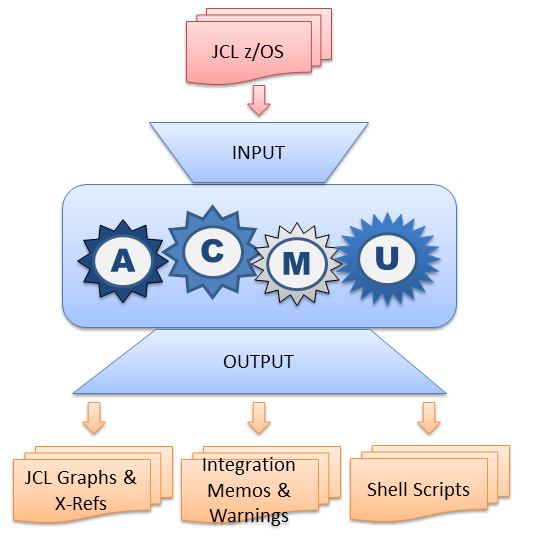
Our JCL converter, ACMU—short for the French “Automate de Conversion MVS/UNIX”—converts MVS JCL into UNIX/Linux shell scripts.
It is not a completely generic tool: it must be adapted to each client's environment.
However, when the JCL is standardised, complies with the site's standards and particular cases have been identified and isolated, ACMU can convert thousands of MVS JCL jobs into UNIX/Linux shell scripts within a few minutes.
Experience shows that 100 lines of JCL generate approximately 400 lines of shell script, including 60% comments for documentation and production operations:
for 1,000 jobs with approximately twelve steps each, this represents 150,000 lines of JCL and 600,000 lines of shell script.
That is around three years of work for a highly skilled UNIX specialist with an expert knowledge of the shell and UNIX system resources, as well as a sound understanding of MVS JCL.

General concept
 ACMU creates a UNIX/Linux shell script from an MVS JCL.
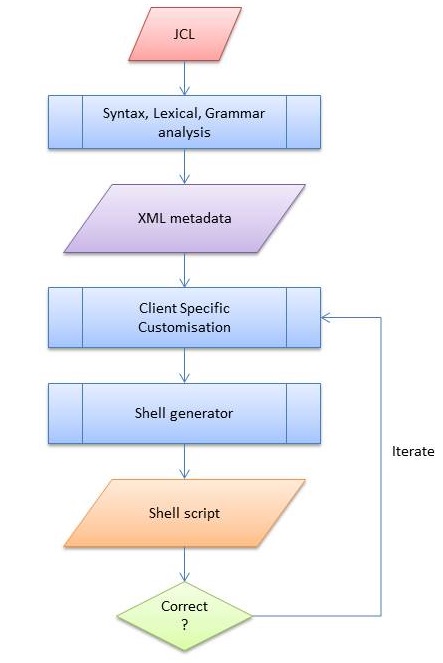
ACMU is designed as a compiler, and operates in 3 phases:
- from a job list, it analyses the MVS JCL and exports it in a portable XML form;
- it produces the corresponding shell scripts from the XML files;
- it produces documentation for each script: a conversion log and an operations sheet.
Phase 1 can run on either the MVS system or the UNIX system.
Phases 2 and 3 run directly on the target UNIX system.
ACMU is based on the following principles:
- each MVS job = one shell script;
- each step = one call to a UNIX program or procedure;
- the resulting shell scripts are 100% standalone and require no specific runtime.
Each output shell script reflects exactly the original JCL logic:
- target script is composed of the original sequence of steps
- Job is restartable at the step level
- it creates one log file for the whole job or one log file per step
- it handles conditions and return codes in the same logic as the original JCL and ends with a MAX Condition Code that your scheduler will process
- Path/file names for programs and data are highly customizable to fit your target environments
- it handles file disposition (DISP=) "à la MVS" as well as GDG files versioning
- invokes programs (Cobol or whatever) passing parameters as well as SYSIN statements
- featuring most common IBM utilities (IDCAMS, IKJEFT01, ..) as shell/Perl procedures
- DF/SORT syntax compatible sort utility
The conversion of each job is based on four elements:
- general conversion parameters;
- the JCL for the job concerned;
- COBOL source programs, if accessible;
- operating conditions on the target system.
These four elements are summarised below:
Main conversion parameters
ACMU settings define:
- the shell to use (ksh, bash, ...);
- the names of UNIX replacements for MVS utilities (catalogues, IDCAMS, IEBGENER...);
- the names of tape drives or cartridge readers, if required;
- the SYSOUT and SYSLOG printer names for each output class;
- the directories corresponding to MVS LOADLIBs;
- the directories for data files and data libraries;
- the directories for COBOL source files during conversion or execution;
- the DDNAMEs for programs where they appear only in DD statements.
The JCL
ACMU's first phase is used when the JCL is standardised and complies with the standards of the MVS site being migrated.
It includes a JCL syntax analyser and an XML parser that converts the JCL into XML.
This phase can run on the source MVS system or on any UNIX or Windows system to which the JCL and, optionally, COBOL source files have been transferred.
The JCL syntax analyser assumes that:
- the first JCL statement is a JOB statement;
- standard files—PDS and sequential datasets—can be converted for use on UNIX, whether fixed or variable, text or binary;
- there are no significant catalogued procedures requiring substitution in DD statements;
- sort parameters are explicit and always include SORT/MERGE and RECORD statements;
- standard utilities are explicitly described in the ACMU parameters, particularly their DDNAMEs when these are implicit, such as SORTIN, SYSIN and SYSUTn.
ACMU supports JCL containing:
- INCLUDE statements
- conditional execution using IF or COND=
- JCL variables
- OPC variables
- concatenated SYSIN statements
- GDGs
The programs
For the shell script to run correctly on the target system, the programs are assumed to meet the following conditions:
- they have all been ported or have an equivalent on the target system;
- they do not require dynamic LINKEDIT loading;
- they are located in the UNIX directory corresponding to their MVS LOADLIB;
- data is located in the UNIX directories corresponding to its MVS locations;
- DDNAMEs are those listed in the corresponding MVS step;
- programs return the same return code on MVS and UNIX.
COBOL programs:
SELECT ddname ASSIGN TO dsname ... clauses are processed as follows:
If the target UNIX COBOL compiler recognises the shell environment variable corresponding to ddname, ACMU generates a UNIX alias of the form 'ddname ==> dsname' from the JCL dsname.
Otherwise, if the COBOL source for the program is available during conversion, ACMU generates a fixed UNIX alias from the dsname.
Otherwise, ACMU generates a call to a routine that performs the same operation dynamically at run time, provided that the COBOL source—or an extract containing the SELECT clauses—is accessible under the same naming conditions.
Otherwise, ACMU generates a default alias, assuming that the program's DSNAME is the same as its DDNAME.
Other programs:
Programs run under IKJEFT01—DB2 programs, CLISTs and REXX procedures—are identified by name from the body of the step's SYSIN DD *, for example SYSTEM(xxx) or RUN PROGRAM(XXXXX) PLAN(YYYY).
In this case, CLISTs and REXX procedures are assumed to have been ported to shell scripts with the same names. Programs that access databases are handled like other programs.
The target system
ACMU assumes the following operating conditions:
- MVS libraries are generally represented by a UNIX directory of the same name, or an alias, containing files with the same names;
- MVS LOADLIBs have a corresponding UNIX directory of the same name, or an alias, containing programs and utilities with the same names;
- similarly, an MVS PDS member such as
AAA.BBB.CCC(DDDD) is stored as a file named DDDD in a directory such as AAA.BBB.CCC or AAA/BBB/CCC;
- the STEPLIB-to-JOBLIB search path remains meaningful when translated into the UNIX PATH;
- for each output class used by the MVS jobs, a real or simulated printer is available through the UNIX lpr command, under a name defined in the ACMU parameters;
- the same principle applies to the simulated MVS log represented by MSGCLASS;
- each MVS utility has a UNIX equivalent with the same name, an alias, or a corresponding name defined in the ACMU parameters, and accepts the same parameter file for explicit SYSIN or SYSUT input;
- a valid DB2 and/or REXX environment is available on the target system for IKJEFT01 steps; a correctly configured UNIX procedure with the same name determines whether to run a DB2 program, REXX procedure or shell script.
For further information, please contact us.